Nutrition research often needs long-term population studies. Used alongside other evidence, they can help guide food advice when decades-long trials aren't practical.

Nutrition advice often depends on evidence from observational studies because long-term diet trials can be difficult or impossible to run. These studies can’t establish cause and effect on their own, but dismissing them simply because they aren’t randomized trials can leave important health questions unanswered.
Randomized controlled trials are a strong way to assess whether an intervention causes a particular outcome. They’re often practical for medicines, but diet poses distinct challenges. Diseases linked to diet may take decades to develop, people can’t be blinded to what they eat, and it can be hard to keep participants on assigned diets for years. Testing outcomes such as heart attacks or cancer would require especially long studies.
Observational research addresses some of these gaps by following large groups over time and examining how eating patterns relate to health. A comparison of findings from observational studies and randomized trials found that results were generally similar in direction and broad size in about 90% of the treatments examined. That comparison doesn’t mean every observational finding is correct. It does suggest that the study design alone doesn’t make such evidence useless.
Different questions call for different evidence
Some apparent conflicts between study types may have explanations. The source article points to hormone replacement therapy as an example: observational research had suggested fewer heart attacks among women taking Premarin, while randomized trials appeared to show the opposite. The author argues that the findings aligned when researchers accounted for when treatment began. The timing of an intervention can matter, so a difference between studies needs to be examined rather than assumed to show that one design failed.
How much certainty is needed also depends on the decision. Medicines can carry serious risks, so their benefits need careful testing against harms. Dietary advice such as reducing sugary drinks or eating more vegetables doesn’t involve the same kind of direct treatment risk. That doesn’t make the evidence unimportant; it means the standard used to judge it should fit the question and the practical consequences of being wrong.
One criticism discussed in the source came from a sugar industry-funded paper that used GRADE, a system commonly applied to clinical recommendations, to rate evidence behind advice to reduce sugar as low quality. The author argues that applying a framework designed around drug trials can underrate nutrition research, where long-term randomized trials may not be feasible.
Nutrition-specific tools offer another way to assess evidence. NutriGrade was designed for nutrition research and includes consideration of funding bias, which can affect how trial results are interpreted. HEALM, short for Hierarchies of Evidence Applied to Lifestyle Medicine, was developed for questions that can’t be answered fully through randomized trials. These tools don’t remove uncertainty; they aim to judge evidence in a way that reflects the methods researchers can realistically use.
Combining methods can strengthen the picture
Each research approach contributes something different. Laboratory research can investigate biological mechanisms. Randomized trials can test whether an intervention causes changes under specified conditions. Large population studies can track many people over long periods, helping researchers examine outcomes that would be difficult to study in a trial. The author discusses these distinct roles in the video Observational Studies Show Similar Results to Randomized Controlled Trials.
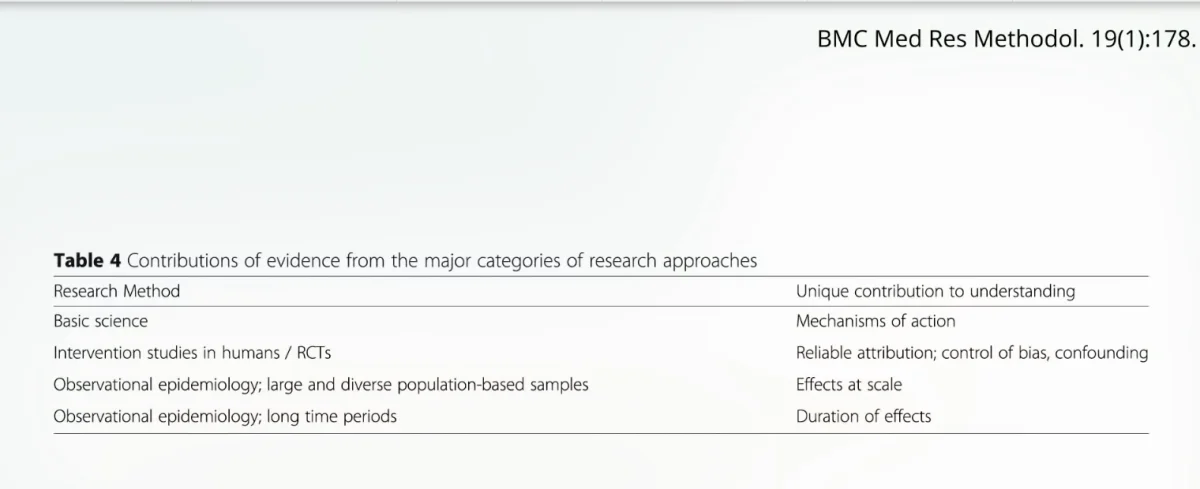
The history of trans fats illustrates how evidence can build across methods. Randomized trials linked trans fats to changes in heart disease risk factors, while population studies found that people who ate more trans fats tended to have more heart disease. Together, those findings supported concern about their health effects, even without trials assigning people to eat trans fats for years and measuring heart attacks or deaths. The source says trans fats were largely removed from the U.S. food supply and cites an estimate that this may have prevented as many as 200,000 heart attacks each year. That estimate is not itself a trial result; it reflects an assessment of the broader evidence and its effects.
The same principle applies to other health risks. Researchers can’t ethically assign children to consume different amounts of lead and follow them to measure harm. Instead, they must draw on available evidence from multiple sources. For diet, observational findings can also inform questions such as whether red meat consumption is linked to colorectal cancer, even when trials with long-term cancer outcomes aren’t available.
How guidelines are judged matters
Evidence-rating systems shape how confident readers and clinicians can be in a recommendation. If a framework gives randomized trials the greatest weight and treats observational evidence as inherently weak, it may rate some nutrition recommendations poorly even when several kinds of evidence point in the same direction. A low rating can describe limitations in the available research; by itself, it doesn’t prove that a recommendation is wrong.
The source also raises concerns about industry funding and how guideline disagreements are presented. It describes papers funded by sugar and meat interests that criticized dietary advice after using GRADE to rate its evidence. Funding does not, on its own, establish that a paper’s conclusions are false. It does make transparent methods, disclosure of financial ties, and independent assessment especially relevant when interpreting claims about the strength of evidence.
Recommendations can change as research develops. The author notes that sugar guidance has varied over time, while describing the more recent guidance as largely consistent, with an earlier Institute of Medicine recommendation as an exception. The source links that outlier to funding ties involving an institute supported by beverage and snack companies. That history is a reason to look closely at both methods and funding when guidelines differ, rather than treating every change as evidence that dietary advice can’t be trusted.
For readers, the useful takeaway is that nutrition evidence rarely rests on a single study type. Observational studies have limits, but they can help answer long-term questions that trials can’t readily address. When weighing a dietary recommendation, consider whether multiple methods support it, how the evidence was assessed, and whether funding could have shaped the work. A clinician or dietitian can help put general dietary findings in context for an individual’s health needs.