In mice, hypothalamic cilia helped connect NAD+ and calorie restriction with healthier metabolic measures. The findings need confirmation in people.
Primary cilia on neurons in the hypothalamus may help explain how changes in NAD+ relate to metabolism and aging. In a study in mice and cultured cells, researchers found that lowering NAD+ shortened these cilia, while raising NAD+ or limiting its breakdown helped preserve their length. The team also found that cilia were needed for some metabolic benefits associated with calorie restriction in aged mice. The results point to a possible biological link, but they don’t show that NAD+ supplements or calorie restriction produce the same effects in people.
Why these small structures matter
Primary cilia are slender projections on the surface of many cells. They help cells receive signals from their surroundings. In the hypothalamus, a brain region involved in regulating energy balance, neuronal cilia are thought to help coordinate signals that affect metabolism.
Earlier research has linked ciliary dysfunction to metabolic problems, including in genetic conditions. Experiments that disrupted cilia in adult mice have also produced metabolic changes. Cilia are connected to autophagy, the cell’s system for breaking down and recycling components; autophagy supports the health of long-lived nerve cells. Because neuronal cilia can become shorter with age, the researchers asked whether NAD+ might affect cilia and, in turn, cellular health.
NAD+ is a molecule used in many cellular processes. Its levels can change with age, and it is connected to the activity of SIRT1, a protein involved in regulating autophagy. The study, published in Aging Cell, investigated how these factors interact.
NAD+ and SIRT1 affected cilia length
In mice, both NAD+ levels and hypothalamic cilia length declined between 3 and 24 months of age. Experiments with cultured hypothalamic neurons offered evidence that the relationship was not simply a coincidence: depleting NAD+ with FK866 shortened cilia, but did not prevent the cells from forming them. Raising NAD+ with its precursors lengthened cilia. Suppressing CD38, an enzyme that consumes NAD+, produced an even stronger effect in these experiments.
The team also observed effects in retinal pigment epithelial cells, suggesting the finding may extend beyond hypothalamic neurons. Experiments that depleted and then restored NAD+ in 3-month-old mice supported a causal relationship between NAD+ levels and cilia length in the hypothalamus. These results are evidence from cells and animals; they don’t establish what would happen in human brains.
SIRT1 appeared to help explain the link. Increasing normal SIRT1 in hypothalamic neurons lengthened cilia, while reducing SIRT1 weakened the effect of raising NAD+. The researchers traced this effect to SIRT1’s deacetylase activity: a modified form of SIRT1 without that activity didn’t produce the same result, and blocking the activity also reduced the cilia response to increased NAD+.
Gene analysis suggested a route through which SIRT1 may influence cilia growth. Increasing SIRT1 raised the activity of several genes associated with cilia length. NAD+ supplied through NMN, a precursor, raised some of those genes as well. The team connected the findings to RFX1, a factor previously linked to cilia growth and to the effects of leptin. In this study, SIRT1’s deacetylase activity appeared to strengthen RFX1’s effect. Disrupting a key autophagy-related gene also blunted SIRT1’s effect on cilia, tying the process to cellular recycling.
Cilia were needed for some effects in aged mice
The researchers tested whether cilia were just associated with these cellular changes or were needed for them. Silencing genes involved in cilia growth reduced NAD+’s beneficial effects on autophagy. The team also studied CHMP4B, a protein found in cilia that helps maintain lysosome integrity. Lysosomes are cell structures that break down and recycle material.
When NAD+ was depleted, CHMP4B became less visible in cilia and shifted toward lysosomes. The researchers also saw the protein move to lysosomes after damaging their membranes. Their results suggest that NAD+ depletion harms lysosomes and draws CHMP4B away from cilia, disrupting a relationship between the two structures. This proposed mechanism helps connect NAD+ to both cilia and autophagy, though the experiments don’t establish how clinically relevant it might be.
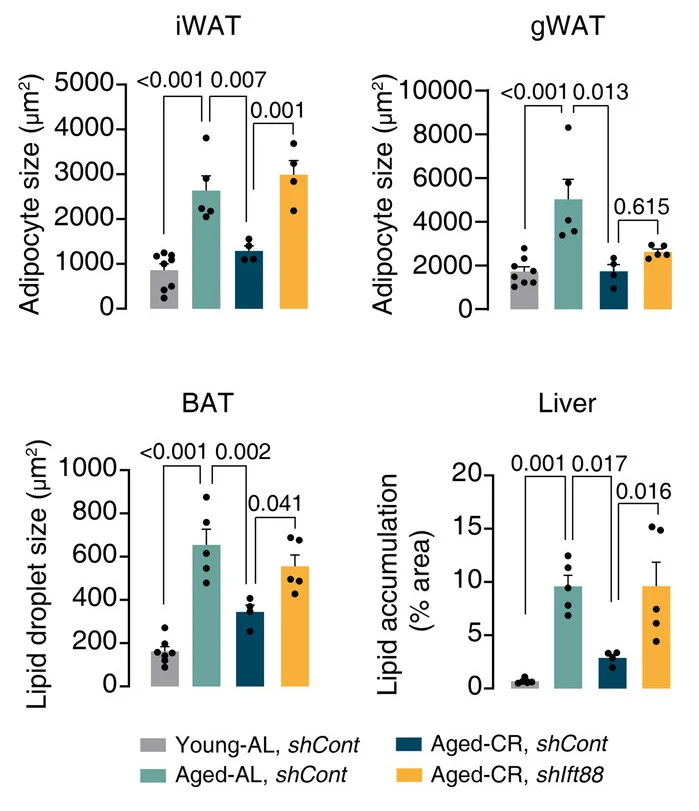
Finally, the team examined calorie restriction in 24-month-old mice. Older mice on the restricted diet had metabolic measurements more like those of younger animals. But when researchers used silencing RNA to suppress a key cilia-growth gene in the hypothalamus, some measures in adipose tissue no longer showed the same improvement. This suggests that hypothalamic primary cilia were required for at least some of the metabolic changes observed in these calorie-restricted mice.
What the findings can—and can’t—tell us
The study brings together several lines of evidence: changes to NAD+ affected cilia in cells and mice; SIRT1 helped mediate those effects; and disrupting cilia weakened effects on autophagy and metabolic measures. That makes cilia a plausible part of the biology behind calorie restriction’s effects in aged mice. It doesn’t show that cilia explain all those effects, or that raising NAD+ or restricting calories would improve health through the same pathway in people.
Further research will need to test how well these findings apply beyond mice and whether the proposed cilia-related mechanisms can be engaged safely in humans. For now, the study offers a possible explanation for how NAD+, autophagy and metabolism intersect, rather than evidence for a treatment. Anyone considering changes to their diet or use of supplements should discuss their circumstances with a doctor or pharmacist.