A woman’s love for a basket-shaped husband challenges her village’s rigid marriages, while the film asks whether affection can withstand possessiveness and habit.
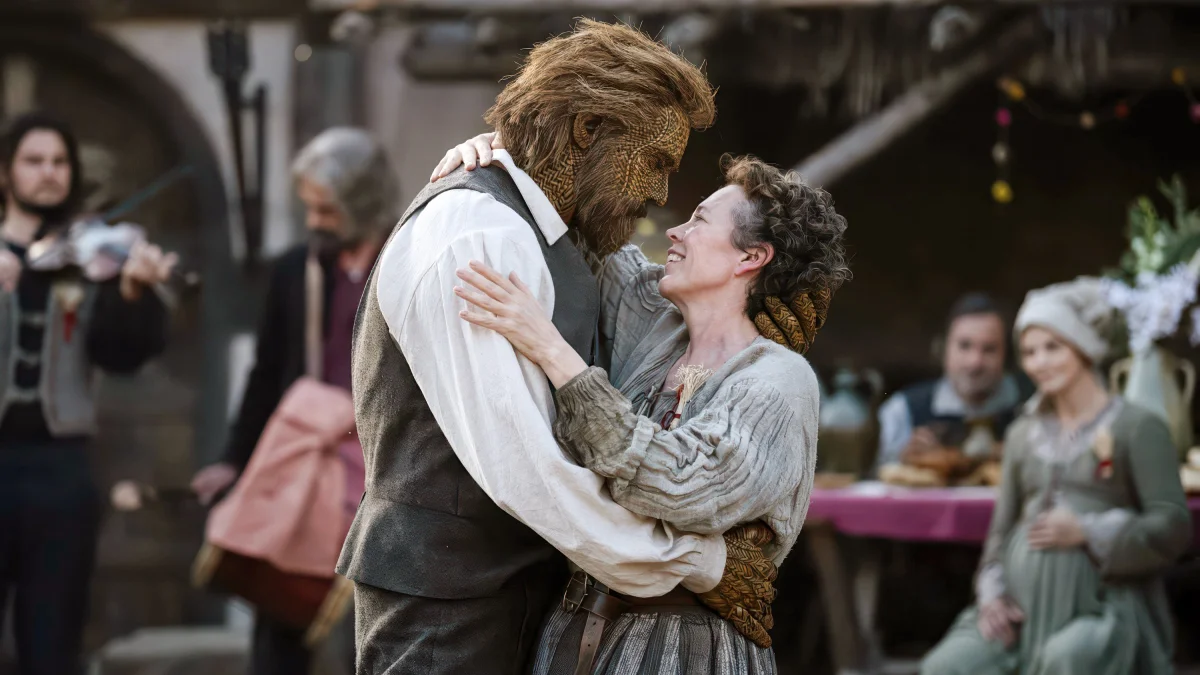
Wicker makes an odd premise carry a familiar question: can marriage make room for love that respects both partners as separate people? The film, directed by Alex Huston Fischer and Eleanor Wilson and based on a short story by Ursula Wills, follows a woman who falls for a person-shaped basket. Its romance is tender and often deliberately silly. Its view of the marriages around them is much harsher.
Olivia Colman plays Fisherwoman, a solitary middle-aged woman who sells her smelly catch in town and returns to a ramshackle cottage. Her neighbors taunt her, and she seems to have settled into a life of evenings alone. Then a local artisan makes her a husband: an affectionate, attentive man whose body is woven from plant fibers. Alexander Skarsgård plays the basket husband, obscured by extensive prosthetics. The setup invites a joke, but the film uses its strangeness to shift attention toward the couple’s behavior. What matters is not how conventional their marriage looks, but how they treat each other.
A village where marriage feels restrictive
The village offers a gallery of relationships drained of ease. Bakerwoman and her husband have stopped having sex. Bottlewasher and his wife still do, though she seems bored. When Tailor’s wife wants to travel and help expand the business, he dismisses her ambition, imagining she should simply wear the clothes and look attractive. These brief portraits make the community’s expectations visible in everyday exchanges: men hold authority, women’s desires get minimized, and routine passes for a settled way of life.
One wedding custom makes that pressure physical. During the ceremony, the officiant tells the groom to fasten a heavy metal collar around his bride’s neck, calling it a “symbol of lifelong duty.” She gasps as he struggles to close it. The image is blunt, but it captures the film’s central unease: a bond meant to signify commitment can also look like confinement.
Fisherwoman and her husband offer a striking counterexample. She earns money; he does not, a reversal that draws notice in a town where little escapes gossip. More significant, he respects her and shows it openly. When someone asks about the collar at their wedding, Fisherwoman answers, “We won’t be needing that.” Their relationship suggests that commitment need not depend on possession or enforced roles.
Happiness changes the people watching
The couple’s affection unsettles the village. Women begin asking more of their husbands, who respond with irritation; one complains that wives have started expecting expressions of gratitude. At a group dance, the townspeople follow set steps, while Fisherwoman and her husband make up their own, holding each other and swaying in the sunlight. The onlookers seem both drawn to their happiness and hostile toward it.
That reaction gives the film’s social critique its force. The villagers may have accepted conventions they never liked because those rules seemed unavoidable. Seeing another kind of relationship makes their own arrangements look less natural and more like habits people keep repeating. Love, in this telling, can loosen those habits by offering a lived example of a different possibility.
The idea has a real-world parallel, though the film’s fantasy is not evidence about relationships. Social scientist Alice Evans has tracked how romantic love has been linked to greater gender equality across different histories and societies. The film takes a more intimate route to a related point: a man’s devotion can include recognizing a woman’s dignity and independence. Still, it doesn’t claim that falling in love automatically changes a person’s values or a community’s structure.
Affection can falter, too
That qualification matters. When men at a bar blame the wicker husband for making their wives dissatisfied, he asks Baker whether he loves his wife. Baker says yes, and for a moment speaks with real tenderness. Soon the group returns to complaining. His loving feeling exists, but it doesn’t by itself undo his assumptions or alter his conduct for long.
Fisherwoman also struggles to live up to the openness her marriage first seems to offer. She becomes anxious about infidelity and treats her husband unkindly. The film’s point is not that a loving relationship is doomed to become controlling. It’s that affection alone doesn’t protect partners from insecurity, complacency, or the pull of familiar expectations. Respect has to show up in how people respond to each other over time.
That tension fits a moment when many people feel uncertain about marriage. A large share of single people say they hope to marry someday, while many don’t know when or how that might happen. Some are looking for a partner; others are dealing with job searches or the cost of housing. People are marrying later and less often on average, giving younger adults particular reason to reconsider traditional milestones, including when and whether to pursue them.
Fisherwoman may seem an unlikely figure for young viewers to recognize: she’s eccentric, middle-aged, and covered in fish. But her conflict is widely legible. At first, she mocks marriage partly because she feels excluded from it. She wants romance and fears the vulnerability it asks of her. “I had such a simple life,” she tells her husband. “It was nothing special, but I knew it. Now you have my heart.”
Wicker is skeptical of marriage as a set of rules, yet it clearly wants connection to succeed. Its more useful question is what partners do after the first rush of feeling: whether they keep seeing each other as people with their own needs and choices, rather than as possessions. Even the film’s seemingly impossible husband has a will of his own. Fisherwoman’s challenge is to recognize that—and to love him with that freedom in view.
[Read: The existential terror of monogamy]
[Read: The bots that women use in a world of unsatisfying men]