A review argues that total SIRT1 and NAD+ levels may miss how well cells respond to stress, and says the proposed measure still needs testing in people.

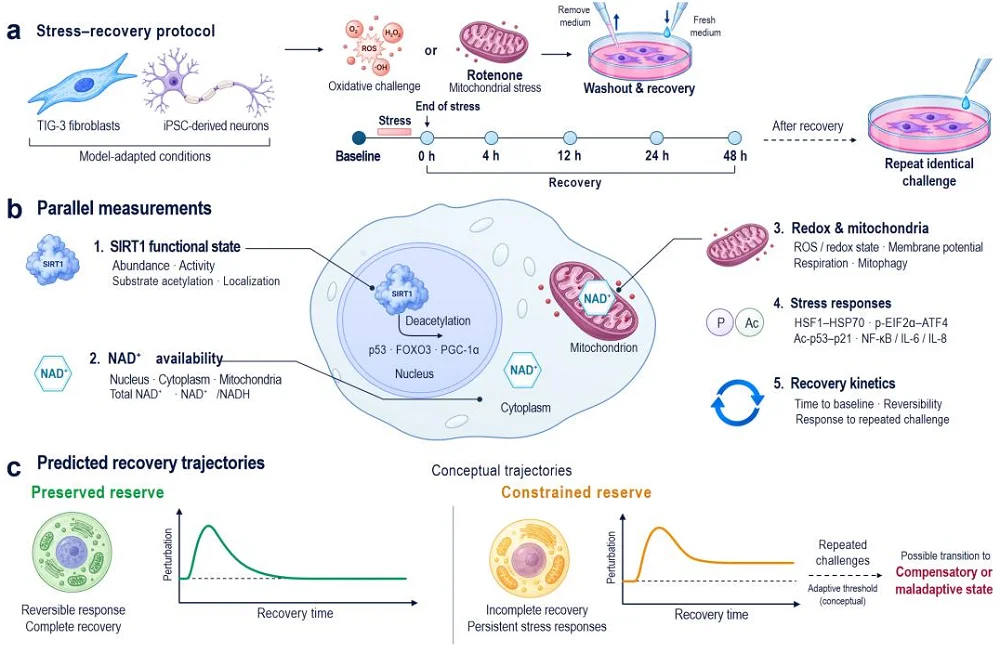
The amount of SIRT1 or NAD+ in a cell may not tell researchers how well that cell can manage stress. A review published in Biology proposes measuring what the authors call “SIRT1 functional reserve”: the capacity of SIRT1-dependent processes to respond to a defined challenge and recover afterward. The idea offers one explanation for why attempts to raise SIRT1 or NAD+ have produced mixed results, but it remains a framework for research, not a validated clinical measure.
SIRT1 is an enzyme that relies on NAD+ and participates in cellular responses to stress. Among its roles, it helps regulate reactive oxygen species (ROS), molecules produced during normal cell activity that also act as signals. With age, the systems that manage ROS can become less well controlled, allowing these molecules to accumulate and contribute to cellular dysfunction.
Simply detecting SIRT1 does not show whether it is active, whether the cell can increase its activity when needed, or whether it can return to a stable state afterward. The review focuses on SIRT1’s connections with redox regulation and mitochondria, where much of the discussion about ROS and energy use converges. The authors stress that their proposed measure covers only part of SIRT1’s activity; it is not a measure of every SIRT1 function or of aging as a whole.
Why total levels can mislead
NAD+ is distributed among different cellular compartments and is used by multiple processes and molecules, including CD38. Although these NAD+ pools may be connected, a high total amount does not guarantee that enough NAD+ reaches SIRT1 in the right place or at the right time to support a response to ROS. Nor does NAD+ abundance necessarily indicate how much SIRT1 is present or functioning.
The same measurement problem applies to SIRT1 itself. The protein occurs in multiple forms, or isoforms. The review notes that the v2 and v3 forms increase with age but are less functional than full-length v1. A measurement that counts all forms together could therefore suggest that SIRT1 is plentiful without showing how much functional capacity remains. Protein changes caused by oxidative or other stresses add another layer: some modifications impair SIRT1, while others can enhance its activity.
These distinctions matter when researchers assess possible therapies. A change in total NAD+ or SIRT1 may not track the activity that a treatment is intended to influence. The review’s proposed approach would examine the forms and locations of both SIRT1 and NAD+, alongside ROS and markers of cellular health and inflammation.
Stress response and recovery are different questions
SIRT1 works within a wider system that senses energy needs and helps cells adapt. That makes its activity difficult to interpret in isolation. For example, a human study of high-intensity interval exercise found increased SIRT1 activity even as total SIRT1 levels fell. The result illustrates why measuring only the amount of the protein can miss changes in what it is doing.
A stronger stress response also does not automatically mean better recovery. A large response could reflect a difficult challenge that remains unresolved; a smaller response might mean the cell handled the challenge with less effort. Age-related changes can affect both the response and the ability to recover, so a single snapshot may not show whether a cell is adapting effectively.
Repeated stress can change SIRT1’s behavior, but the review cautions that this does not necessarily mean SIRT1 has lost function. Its role also connects to proteostasis—the processes that maintain and manage proteins. SIRT1 regulates the heat shock factor HSF1, which helps control heat shock proteins involved in protein maintenance. Some heat shock proteins, in turn, affect SIRT1. If this relationship is disrupted, the systems that support protein quality may weaken one another. SIRT1 also contributes to protein maintenance in mitochondria.
Because SIRT1 operates in a network, increasing its activity may have diminishing effects if another part of the cell’s response has become the limiting factor. That possibility could help explain why efforts to enhance SIRT1 have not delivered consistent results. Measuring its functional reserve would require researchers to account for these connected processes rather than treating SIRT1 as an independent switch.
Cell type and stress history matter
The transition from adaptation to dysfunction appears gradual. During prolonged stress, cells may rely continually on compensatory responses or undergo structural changes. SIRT1 can participate in those responses, while changes such as cellular senescence can alter what a given amount of SIRT1 is able to accomplish. As the review puts it, the same level of SIRT1 protein or activity may produce different results in different cellular conditions. The authors therefore suggest including a cell’s history of stress when estimating its reserve.
Findings also vary by species, tissue and cell type. Experiments in human cells have linked higher oxidative stress with lower SIRT1. In mice, caloric restriction and exercise have affected SIRT1 differently across tissues. Neural stem cells may be especially sensitive to changes in SIRT1. These examples make broad measurements from blood or other accessible samples hard to interpret as a picture of what is happening in a specific tissue.
For people managing their health, the review does not establish that a SIRT1 or NAD+ supplement will prevent or treat age-related disease. It also does not provide a clinical test for deciding whether an intervention is working. Anyone considering a supplement or a change to treatment can discuss the evidence and possible interactions with a doctor or pharmacist.
What researchers need to establish
The review offers a rationale for the mixed results seen with approaches that raise SIRT1 or NAD+, and with MitoQ, a compound studied as a way to target oxidative stress in mitochondria. It does not show that these approaches are effective or ineffective as a group. The authors also acknowledge that their functional-reserve framework needs experimental validation.
Next steps would include testing whether measures of SIRT1 forms and cellular locations, NAD+ distribution, ROS and other health markers can capture a cell’s response and recovery. The central question is whether changes in SIRT1-dependent adaptive capacity connect to outcomes that matter to people. Establishing that link will take substantial research. Until then, functional reserve is a promising way to frame the measurement problem, not proof that a more precisely targeted therapy will work in humans.
Literature
[1] Sies, H., Mailloux, R. J., & Jakob, U. (2024). Fundamentals of redox regulation in biology. Nature Reviews Molecular Cell Biology, 25(9), 701-719.
[2] Atayik, M. C., & Çakatay, U. (2023). Redox signaling and modulation in ageing. Biogerontology, 24(5), 603-608.
[3] Covarrubias, A. J., Perrone, R., Grozio, A., & Verdin, E. (2021). NAD+ metabolism and its roles in cellular processes during ageing. Nature Reviews Molecular Cell Biology, 22(2), 119-141.
[4] Chini, C. C., Peclat, T. R., Warner, G. M., Kashyap, S., Espindola-Netto, J. M., de Oliveira, G. C., … & Chini, E. N. (2020). CD38 ecto-enzyme in immune cells is induced during aging and regulates NAD+ and NMN levels. Nature Metabolism, 2(11), 1284-1304.
[5] Høyland, L. E., VanLinden, M. R., Niere, M., Strømland, Ø., Sharma, S., Dietze, J., … & Ziegler, M. (2024). Subcellular NAD+ pools are interconnected and buffered by mitochondrial NAD+. Nature Metabolism, 6(12), 2319-2337.
[6] Patyal, P., Ameer, F. S., Verma, A., Zhang, X., Azhar, G., Shrivastava, J., … & Wei, J. Y. (2024). The role of Sirtuin-1 isoforms in regulating mitochondrial function. Current Issues in Molecular Biology, 46(8), 8835-8851.
[7] Caito, S., Rajendrasozhan, S., Cook, S., Chung, S., Yao, H., Friedman, A. E., … & Rahman, I. (2010). SIRT1 is a redox-sensitive deacetylase that is post-translationally modified by oxidants and carbonyl stress. The FASEB Journal, 24(9), 3145.
[8] Han, C., Gu, Y., Shan, H., Mi, W., Sun, J., Shi, M., … & Yu, W. (2017). O-GlcNAcylation of SIRT1 enhances its deacetylase activity and promotes cytoprotection under stress. Nature Communications, 8(1), 1491.
[9] Lomeli, N., Bota, D. A., & Davies, K. J. (2017). Diminished stress resistance and defective adaptive homeostasis in age-related diseases. Clinical Science, 131(21), 2573-2599.
[10] Cantó, C., Jiang, L. Q., Deshmukh, A. S., Mataki, C., Coste, A., Lagouge, M., … & Auwerx, J. (2010). Interdependence of AMPK and SIRT1 for metabolic adaptation to fasting and exercise in skeletal muscle. Cell Metabolism, 11(3), 213-219.
[11] Gurd, B. J., Perry, C. G., Heigenhauser, G. J., Spriet, L. L., & Bonen, A. (2010). High-intensity interval training increases SIRT1 activity in human skeletal muscle. Applied Physiology, Nutrition, and Metabolism, 35(3), 350-357.
[12] Lamech, L. T., & Haynes, C. M. (2015). The unpredictability of prolonged activation of stress response pathways. The Journal of Cell Biology, 209(6), 781.
[13] Zhang, J., Wang, H., Slotabec, L., Cheng, F., Tan, Y., & Li, J. (2023). Alterations of SIRT1/SIRT3 subcellular distribution in aging undermine cardiometabolic homeostasis during ischemia and reperfusion. Aging Cell, 22(9), e13930.
[14] Westerheide, S. D., Anckar, J., Stevens Jr, S. M., Sistonen, L., & Morimoto, R. I. (2009). Stress-inducible regulation of heat shock factor 1 by the deacetylase SIRT1. Science, 323(5917), 1063-1066.
[15] Białopiotrowicz-Data, E., Noyszewska-Kania, M., Jabłońska, E., Sewastianik, T., Komar, D., Dębek, S., … & Juszczyński, P. (2023). SIRT1 and HSP90α feed-forward circuit safeguards chromosome segregation integrity in diffuse large B cell lymphomas. Cell Death & Disease, 14(10), 667.
[16] Chen, Q., Chang, Y. L., Hung, M. W., Lee, P. L., Hsin, C., & Lin, Y. F. (2026). Sirt1 coordinates the mitochondrial UPR and myocellular proteostasis to preserve muscle integrity during muscle atrophy in zebrafish. Frontiers in Cell and Developmental Biology, 14, 1761278.
[17] Alcendor, R. R., Gao, S., Zhai, P., Zablocki, D., Holle, E., Yu, X., … & Sadoshima, J. (2007). Sirt1 regulates aging and resistance to oxidative stress in the heart. Circulation Research, 100(10), 1512-1521.
[18] Wang, G., Wang, F., Ren, J., Qiu, Y., Zhang, W., Gao, S., … & Xu, J. (2018). SIRT1 involved in the regulation of alternative splicing affects the DNA damage response in neural stem cells. Cellular Physiology and Biochemistry, 48(2), 657-669.
[19] Broome, S. C., Whitfield, J., Janssens, K., & Hawley, J. A. (2025). MitoQ supplementation does not impact redox responses to acute exercise in skeletal muscle of older individuals. Redox Biology, 103927.
===