A bacterial fatty acid lowered cholesterol and plaque in mice through a pathway also targeted by statins. Human studies are still needed.
A molecule made by a gut bacterium lowered cholesterol and slowed artery plaque buildup in mice, according to a study published in Nature. The findings point to a possible connection between gut microbes and cholesterol control, but they don’t show that the molecule prevents heart disease in people or can replace established treatment.
What the mouse study found
The researchers began by comparing gut microbe data from people with atherosclerotic cardiovascular disease and healthy controls. Among the bacteria they examined, Bacteroides uniformis was most abundant in the healthy group. That association helped guide the next experiments, but by itself it can’t show that the bacterium caused better health.
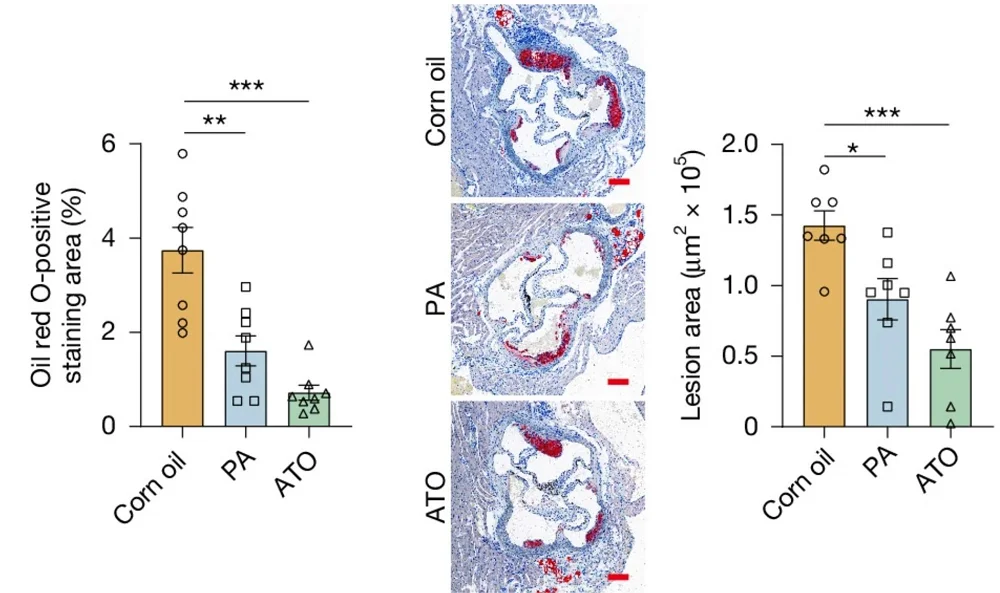
The team then tested the bacterium in male mice without a working Apoe gene. These animals are prone to artery plaque, especially when fed a high-fat diet. Over 12 weeks, mice given B. uniformis developed less plaque in the aorta and at its root than mice given a vehicle control. Their measured plaque burden, LDL cholesterol, total cholesterol, and triglycerides were also lower. HDL cholesterol did not change significantly.
Atorvastatin, a cholesterol-lowering medicine, served as a comparison. Its effects were similar or somewhat greater than those of the bacterium. The study did not measure plaque at the start of the experiment, so its results support slower plaque development during treatment, not the claim that existing plaque was reversed.
The treated mice also had fewer macrophages in their plaques. These immune cells can take up fats and contribute to plaque growth. The researchers observed changes in the local immune environment that pointed toward less inflammation, along with reductions in systemic inflammation measures in later experiments.
How a bacterial fatty acid may act
In the liver, B. uniformis increased the activity of LDL receptors, which help liver cells take LDL particles out of the blood. The bacterium also activated SREBP2, a protein involved in the cell’s response to cholesterol levels. When the researchers selectively disabled LDL receptors in the liver, the bacterium no longer improved blood lipids, plaque burden, or inflammation. This suggests that those receptors are necessary for the effects seen in these mice.
The team found that the bacterium reduced cholesterol synthesis in the liver. Their proposed explanation is that lower cholesterol production inside liver cells triggers a response involving SREBP2 and more LDL receptors. The liver then draws more LDL from the bloodstream. The experiments support this pathway in mice; they don’t establish how important it is in people.
The researchers also tested whether the effect depended on living bacteria. Dead bacteria didn’t produce the same results, while an extract from the bacteria’s culture fluid did. That pointed to a substance released by active bacteria. The team identified it as pentadecanoic acid, also called C15:0, a saturated fatty acid with 15 carbon atoms.
In a separate experiment, mice received purified C15:0 for eight weeks. At the tested schedule, the molecule reduced plaque burden by about 50% and lowered LDL and total cholesterol. It also reduced plaque macrophages and measures of inflammation. Atorvastatin had a noticeably stronger effect in this comparison.
The researchers found that C15:0 lowered cholesterol in cells and in the liver. They also reported that it bound to and inhibited HMG-CoA reductase, an enzyme involved in cholesterol production and the target of statin medicines. C15:0 inhibited the enzyme less strongly than atorvastatin, which fits with its smaller effect on plaque in the mouse experiments. The authors suggest that longer exposure to C15:0 in mice might partly offset its weaker inhibition.
What the human findings can—and can’t—tell us
The researchers measured C15:0 in people with dyslipidemia, meaning unusually high blood lipid levels, and in healthy controls. C15:0 concentrations were lower in the dyslipidemia group. They also reanalyzed existing gut microbe data and found fewer genes associated with C15:0 production among people with atherosclerotic cardiovascular disease.
These human observations don’t establish cause and effect. Lower C15:0 could be related to other differences between the groups, and the data don’t show that taking C15:0 would lower cholesterol or prevent artery disease in people. The central treatment evidence comes from mice, including animals with a specific genetic change that makes them prone to plaque. Results in this model may not predict the size or safety of an effect in people.
C15:0 is available as a supplement, but this research doesn’t establish that a supplement is better than statins, or that it is a suitable substitute. The study also doesn’t answer whether C15:0 has a different safety profile or what level of exposure would be appropriate for people. Anyone considering a supplement, or weighing options for cholesterol management, can discuss the evidence and their circumstances with a doctor or pharmacist. The practical next step is human research that measures both benefit and safety.
Study: Yin, C., Chen, Y., Lin, G. et al. (2026). A gut microbial odd-chain fatty acid alleviates atherosclerosis in mice. Nature.
Related research: Haghikia, A. et al. (2022). Propionate attenuates atherosclerosis by immune-dependent regulation of intestinal cholesterol metabolism. European Heart Journal, 43(6), 518–533.
Related research: Jie, Z. et al. (2017). The gut microbiome in atherosclerotic cardiovascular disease. Nature Communications, 8(1), 845.
Additional reading: Ethics code of longevity journalism; Ways to support the organization.