Two nutrition reviews drew scrutiny over industry ties and methods, illustrating why funding and research independence matter when weighing dietary advice.

Nutrition recommendations can be shaped by more than the evidence they assess. A pair of reviews published four years apart in the Annals of Internal Medicine drew scrutiny over their conclusions and their connections to food industry funders. Together, the episodes show why readers and researchers need to examine how a review was funded, who directed its work, and whether its methods support its claims.
A review challenged advice on sugar
In 2015, the U.S. Dietary Guidelines recommended reducing sugar intake. A review sponsored by the International Life Sciences Institute (ILSI) later argued that the evidence behind sugar recommendations was too weak to support trustworthy guidance. Its conclusion appeared in the Annals of Internal Medicine in 2016, under the title “The Scientific Basis of Guideline Recommendations on Sugar Intake.”
ILSI is a nonprofit established by a Coca-Cola executive. The source describes the organization as funded by large companies across food, agriculture, and pharmaceutical industries, and reports that it had roughly 400 corporate members and a $17 million budget. Coca-Cola and PepsiCo were among the companies named. Those ties matter when an organization sponsors research that assesses advice affecting the products its members sell.
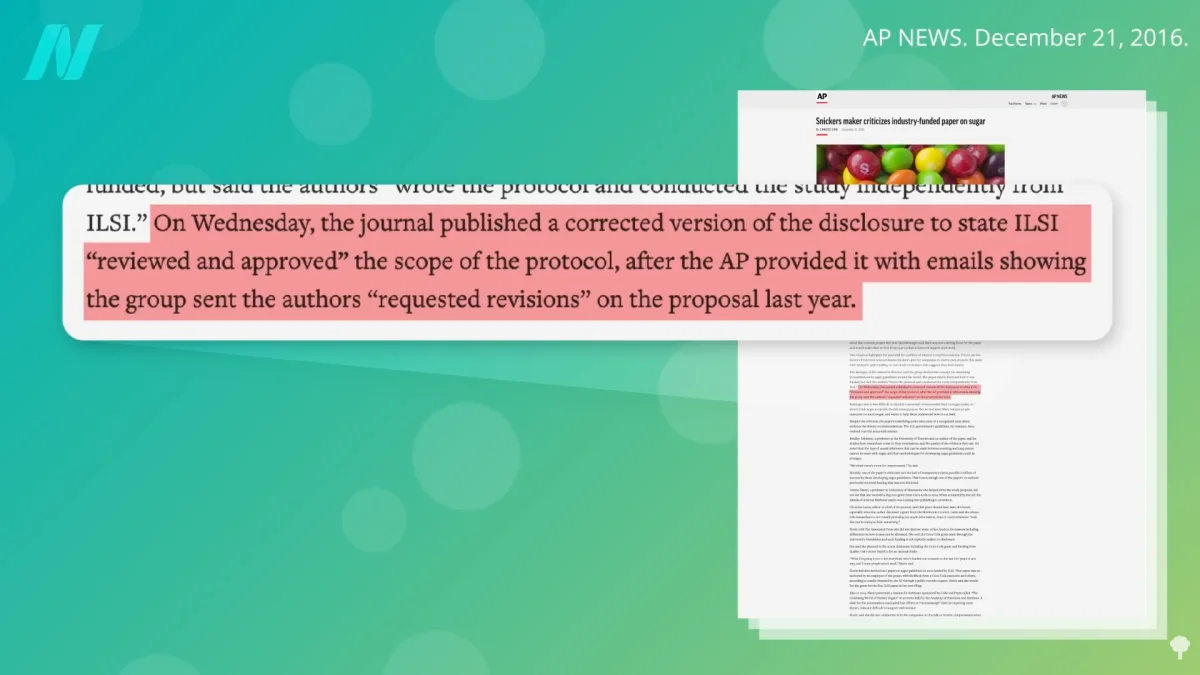
The review’s authors said they had written the protocol and conducted the work independently of ILSI. That account was later challenged. Emails obtained by the Associated Press showed that ILSI had requested revisions, prompting the journal to publish a corrected version. The reporting also found that one co-author had received a $25,000 Coca-Cola grant that had not been disclosed directly. These details raise questions about how much control the sponsor had over the work and whether readers had enough information to assess potential conflicts.
Nutrition professor Marion Nestle criticized the review, describing it as an example of industry funding shaping scientific opinion. The source also reports that Mars, despite being an ILSI member, publicly criticized the paper. The disagreement highlights that industry involvement does not mean every company shares the same position, and that a funding connection alone cannot establish whether a particular conclusion is wrong. It does make transparency and independent scrutiny especially important.
Funding can be associated with favorable conclusions
A cited analysis of nutrition research found that studies with industry funding had roughly seven to eight times the odds of reaching conclusions favorable to the funder compared with studies without industry funding. In the analysis of intervention studies, none reached an unfavorable conclusion about the funder’s own products. These findings describe patterns across research; they do not prove that every industry-funded paper is biased or that its results should be dismissed without examining its methods.
Funding can affect research in several ways, including which questions are studied, how comparisons are designed, and how results are interpreted. A review may also reach a conclusion that differs from the evidence it summarizes if its criteria for judging study quality or weighing outcomes are disputed. Readers therefore benefit from looking beyond the abstract: check the funding and conflict disclosures, the protocol, the review’s methods, and whether other researchers reach similar conclusions.
A later review questioned advice on meat
In 2019, a series of reviews assessed evidence on red and processed meat. The reviews reported that dietary patterns with lower intake of these meats may be associated with lower risks of premature death, cardiometabolic disease, and cancer. Yet the accompanying recommendations advised people to continue their current consumption of both unprocessed red meat and processed meat.
The lead author was Bradley Johnston, who had also led the earlier sugar review. The source presents this later work as another case in which the relationship between sponsorship, methods, and conclusions deserves close examination. The recommendation itself should be understood in the context of the reviews’ approach and the evidence they assessed; it does not establish that meat intake has no health effects or that every reader faces the same risks.
Observational findings about diet can be difficult to interpret because eating habits cluster with other behaviors and circumstances. Reviews must decide how to weigh different study designs, outcomes, and levels of certainty. Those judgments can produce different recommendations from similar bodies of evidence. Clear explanations of those choices help readers understand why a conclusion was reached and how much confidence it warrants.
What journals and readers can look for
Some medical journal editors have argued that journals should refuse research funded by industries whose products are being evaluated, pointing to editorial practices used to limit tobacco industry influence. The source suggests that journals could apply a similar approach to studies of added sugar funded by companies with commercial interests in the outcome. Whether journals adopt that standard or another safeguard, full disclosure and independent editorial review are central to evaluating contested research.
For readers, the practical message is to treat a single review as one part of a larger evidence base. Look for whether its findings match other reviews, whether the recommendation follows from the results, and whether sponsor involvement is clearly described. A funding tie is a reason to examine a paper carefully, not a substitute for examining it.
The 2019 meat reviews followed a 2015 scientific report that had encouraged eating less sugar and less meat. The source frames the reviews as part of a wider debate about how commercial interests can shape nutrition research and guidance. The next useful question is how the meat review evaluated the underlying studies and arrived at its recommendations—a question the source’s planned follow-up addressed.
The source is the first entry in an eight-part series on industry influence in nutrition research and guidance. Related material examines conflicts of interest on the Dietary Guidelines Advisory Committee and the history of the McGovern Report.
2019 review series · Review conclusion · Earlier review conclusion · Dietary pattern findings · Risk findings · Meat recommendations · 2015–2020 dietary guidance · Research on tobacco industry influence · Reporting on ILSI · Analysis of sugar guidance · Sugar review · Reporting on the sugar review · Associated Press reporting · Analysis of nutrition research funding · Journal editorial on industry influence · Guidance committee handout · 2015 committee scientific report · Source video on sugar guidance · Related material on committee conflicts · Related history of the McGovern Report