Cell and animal findings link MTR4 to lower signs of vessel cell aging, but they don’t show whether targeting it could benefit people.
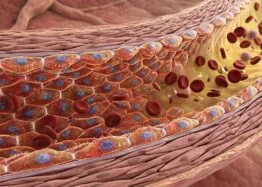
MTR4, a protein involved in managing RNA, may help blood vessel cells resist some features of aging, according to a study published in Aging Cell. Experiments in human cells and mice linked higher MTR4 levels with fewer signs of cellular senescence and better measures of vascular function. The findings point to a possible way to support aging vessel cells, though they don’t establish a treatment for people.
Why researchers focused on vessel cells
Vascular endothelial cells (VECs) form the inner lining of blood vessels and help control what passes through it. Because they’re exposed to substances circulating in the blood, they face ongoing stress. When they enter senescence, a state in which cells stop dividing but remain active, they can release a mix of signaling molecules known as the senescence-associated secretory phenotype, or SASP.
Senescent VECs have been linked with cardiovascular conditions and other diseases, including high blood pressure and diabetes. Their location in the blood vessels makes them an appealing research target. But eliminating these cells isn’t necessarily beneficial: previous mouse studies cited by the authors found that removing certain senescent cells could worsen fibrosis, shorten lifespan, or aggravate high blood pressure.
This study instead examined whether strengthening the cells might help. The researchers chose MTR4, an RNA helicase involved in RNA maintenance and cell-cycle processes. Earlier work had connected disruption of some MTR4 functions with senescence, but its role in regulating senescence had not been directly tested.
Cell experiments point to a protective role
The team used human umbilical vein endothelial cells, or HUVECs, and induced senescence in three ways: exposure to DNA-damaging agents, oxidative stress, and repeated cell division. MTR4 protein levels fell in each group. The decline did not appear in nondividing stem cells that were quiescent but not senescent, suggesting the change was associated with senescence rather than simply a lack of cell division.
Samples from mice showed a similar age-related pattern. Three-month-old mice had more MTR4 than 20-month-old mice in several organs, including the heart, liver, and aorta. These observations show an association with age; on their own, they don’t explain what causes MTR4 to fall or whether the pattern applies in people.
The researchers then changed MTR4 levels in the human cells. Silencing the gene in actively growing HUVECs raised senescence markers, including SA-β-gal, and increased expression of SASP factors. In a reverse experiment, raising MTR4 in cells made senescent through repeated division partly reduced senescence-related features, including a broad drop in SASP expression. The effects were partial, rather than a full return to a younger cell state.
A protein pathway offers a possible explanation
To investigate how MTR4 might act, the authors analyzed RNA and examined proteins that could interact with it. They identified 92 possible interacting proteins and narrowed their attention to five candidates using the GenAge database. Experiments identified a physical interaction between MTR4 and BUB3. Increasing BUB3 produced effects similar to increasing MTR4, while a modified MTR4 that could not bind BUB3 did not produce the same benefit.
The team’s results suggest that MTR4 stabilizes BUB3. BUB3, in turn, stabilizes BUBR1, a protein involved in the spindle assembly checkpoint. This checkpoint helps preserve DNA as cells divide. The authors propose that this MTR4–BUB3–BUBR1 chain helps limit DNA damage and, in turn, senescence. The experiments support this mechanism in the models studied, but they don’t establish that it explains vascular aging in humans.
One detail stood out: although MTR4 protein declined in senescent cells, MTR4 RNA expression rose. The researchers concluded that the protein was being broken down more quickly. They linked its degradation to the ubiquitin-proteasome system, which helps cells dispose of proteins, rather than to autophagy. The study implicated increased levels of SYVN1 in this process and identified the K638 lysine on MTR4 as part of the ubiquitination mechanism.
Animal findings remain early evidence
In mice, the researchers used adeno-associated viruses to raise or lower Mtr4. Aged mice with increased Mtr4 showed better vascular function and more exploratory behavior. Young mice with reduced Mtr4 showed poorer vascular function and less exploratory behavior. These results extend the cell findings to animals, but changes in behavior and vessel function in mice don’t show that the same approach would be safe or effective in people.
The team also reported lifespan effects in C. elegans, a small roundworm often used in aging research. Worms with more mtr-4 lived longer than unmodified worms, with lifespans approaching those of known long-lived mutants. Worms with less mtr-4 had shorter lifespans. These findings suggest the protein’s role may be conserved across species, while leaving open how relevant the worm results are to human health.
What the results mean
The study builds a case for MTR4 as a regulator of senescence in vascular cells, supported by experiments in cultured human cells, mice, and worms. It does not show that MTR4-based treatments can prevent cardiovascular disease, extend human lifespan, or reverse vessel aging. Any future treatment would also need to address how to affect MTR4 safely and selectively. For now, the value of the work is in clarifying a possible cellular pathway that researchers can investigate further.
===