Research suggests curls and hinges train different parts of the hamstrings. Seated curls look promising, while evidence remains limited.
Squats and leg presses may train the front of the thighs well, but they appear to do relatively little for hamstring growth. Research on exercise selection points to a more targeted approach: combine knee-bending leg curls with hip hinges, since each movement may emphasize different hamstring muscles. The evidence comes from a handful of training studies, so these patterns are useful guides rather than settled rules.
Why squats may miss the hamstrings
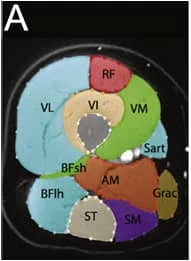
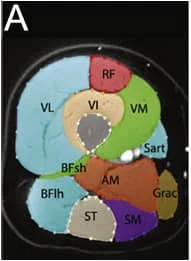
The hamstrings include four muscle heads: the long and short heads of the biceps femoris, the semitendinosus, and the semimembranosus. All four help bend the knee. The short head of the biceps femoris differs from the others because it doesn't cross the hip; the other three also help extend it.
This anatomy helps explain why squats may not be a reliable way to grow the hamstrings. In a squat, the hips and knees extend at the same time. The hamstrings can assist hip extension, but their action at the knee also resists the knee extension produced by the quadriceps. Other muscles, including the gluteus maximus and adductor magnus, can contribute to hip extension without creating the same conflict. That may leave the hamstrings with less of a growth stimulus.
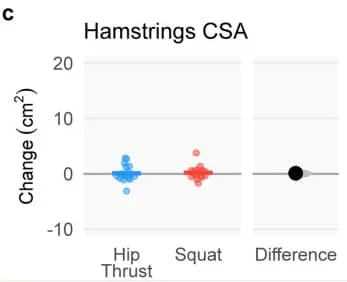
Research findings fit that explanation. One study compared barbell squats with hip thrusts and found little hamstring growth from either exercise. Another compared squats that reached 90 degrees of knee bend with deeper squats reaching 140 degrees; neither version produced much hamstring growth. These results don't mean squats have no value. They suggest that exercises focused on both hip and knee extension may not provide enough direct work for this muscle group.
For a hip hinge to place more demand on the hamstrings, the knee generally needs to stay fairly still. Stiff-legged deadlifts and back extensions are examples of hinge-style exercises. Leg curls train the hamstrings through knee flexion, giving the two exercise types distinct roles.
Hinges and curls may emphasize different muscles
Several studies have compared the effects of these movements on individual hamstring muscles. In a study by Kawama and colleagues, participants trained with an eccentric-only stiff-legged deadlift using partial repetitions in the lengthened position. The long head of the biceps femoris, semimembranosus, and semitendinosus grew, while the short head of the biceps femoris showed less growth.
Bourne and colleagues compared a 45-degree back extension with the Nordic hamstring curl. The back extension produced greater growth in the long head of the biceps femoris and semimembranosus. The Nordic curl produced greater growth in the short head and semitendinosus.
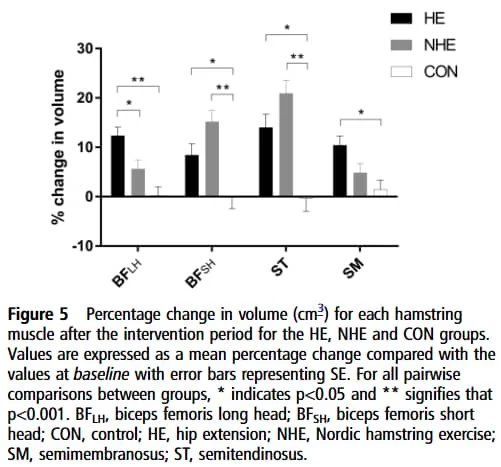
A later study by Morin and colleagues compared Nordic curls with stiff-legged deadlifts. The Nordic curl produced greater semitendinosus growth, while the stiff-legged deadlift produced greater semimembranosus growth. Growth of the biceps femoris long head was similar. The researchers didn't measure the short head.
Across these studies, hip hinges appear to favor the biceps femoris long head and semimembranosus, while curls may give more attention to the semitendinosus and short head. The findings make a case for including both movement types. They don't establish that every person will respond in the same way, or that one exercise variation is best for every training goal.
Choosing a leg curl
Two studies by Maeo and colleagues offer clues about curl variations. In the first, seated and lying leg curls were compared. Sitting with the hips bent places the hamstrings that cross both the hip and knee in a longer position than lying does. The seated curl produced greater growth in those muscles. The lying curl produced more growth in the sartorius, a muscle that bends the knee and hip.
The second study compared a seated leg curl performed with a forward lean against the Nordic curl. The seated curl led to greater growth in the biceps femoris long head and semimembranosus. The Nordic curl led to greater growth in the short head and sartorius. Growth in the semitendinosus, gracilis, and popliteus was similar between the groups.
These comparisons suggest that seated curls may be a useful choice when the aim is to train the hamstrings broadly, particularly the muscles that cross the hip and knee. Lying curls and Nordic curls may add different stimuli. But the studies tested curls in particular combinations; results could differ when participants also perform hip hinges.
Other details and what to take from the research
A conference abstract from Maeo and colleagues compared full-range repetitions on a multi-hip machine with partial repetitions performed in the stretched position. Growth in the hamstrings and glutes was generally greater with the lengthened partial repetitions. Because the findings are available as an abstract, they offer a preliminary signal rather than a firm basis for a training prescription.
Cadeo and colleagues tested whether ankle position during lying leg curls affected growth of the biceps femoris long head. Pointing the toes or pulling them upward changes the calf muscle gastrocnemius's length; that muscle also bends the knee. The study found no difference in biceps femoris growth between ankle positions, suggesting that choosing the position that feels comfortable is reasonable based on this result.
For adults planning strength training, the practical takeaway is that hamstring work may benefit from both a hip hinge and a leg curl, with seated curls a promising option. These studies examined muscle growth, not whether a particular routine prevents hamstring strains or suits someone with an injury. Anyone managing pain, a previous strain, or another health concern can discuss appropriate exercise choices with a clinician or qualified exercise professional.
The research cited here was featured in Stronger by Science; the site is the publisher.